
Last Updated on August 20, 2026
Glacier National Park is a giant National Park in Montana, covering 1,013,126 acres (1,583 square miles) and spanning two mountain ranges. Then there are obligatory shuttle buses for certain routes that require advance bookings, and a vast trail network to choose from, and over 3 million annual visitors – it can be overwhelming. Most visitors come with limited time, which means you should really do some research prior to your visit to optimize your time in the park. The park being divided into two parts, East Glacier and West Glacier, which are quite far from one another, additionally complicates things. A visit to Glacier without advance planning can be frustrating, which is why I wanted to share a few facts you should know prior to visiting Glacier National Park, and the things you need to plan & research before arriving at the park.
What to know before visiting Glacier National Park
Research which trails you’d like to do
Glacier National Park is absolutely massive and has over 700 miles of hiking trails. In total, the park features 58 different trails – you could spend a couple of weeks in the park, and you’d still not be able to hike all the trails, and most people only have a couple of days in the National Park.
It definitely pays off to look into all the available hikes, and to decide which ones are you “must do” hikes, and which ones are good alternatives, in case the trails you’d like to do are closed. Speaking of which:
Be flexible with your hikes
Understand that it may not possible to do all the hikes you’d like to do – not because of time constraints, but because hiking trails frequently close to do bear activity or other hazards. In fact, three of the hikes I wanted to do were not open yet, because the trailheads are off the Going-To-The-Sun Road, which hadn’t opened yet for the season.
Note: If the Going-To-The-Sun Road isn’t open yet, you won’t be able to get on these popular trails: the Highline Trail, Hidden Lake Trail, Siyeh Pass. These trails can still be closed later in the season, even after the Going To The Sun Road opens, because there’s still snow in the higher-up regions.
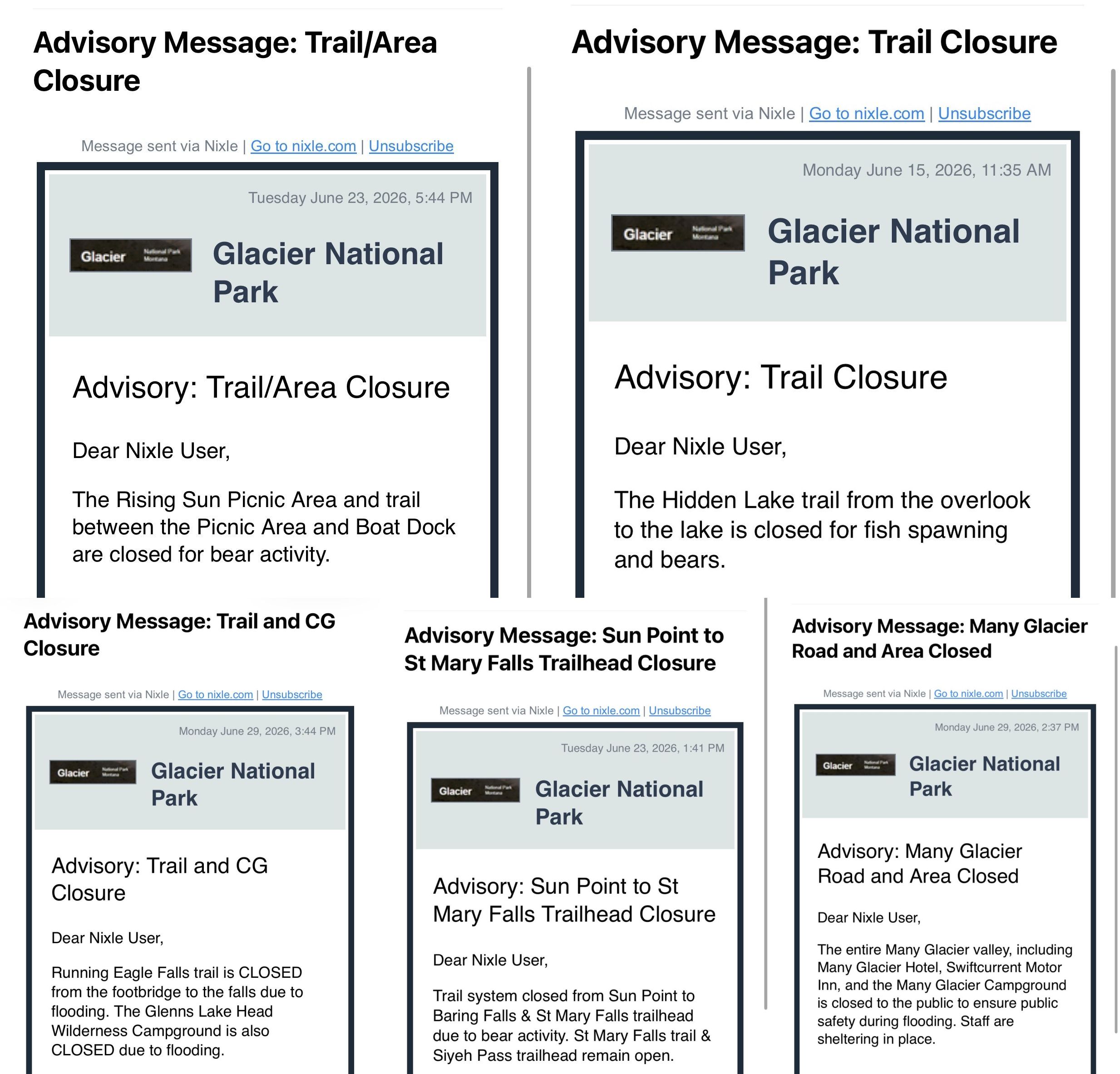
When we visited in June 2026, the number one trail on our list, Grinnell Glacier, was still closed after a bear attack a couple of weeks prior to our visit. Two weeks after we left, the entire Many Glacier area, which includes dozens of popular trails, was closed off after heavy flooding – including the popular Many Glacier Hotel. Activities in that area, such as horseback riding and boat rides across the Swiftcurrent and Josephine Lakes, were suspended. Have a backup plan in place in case the hikes of your choice aren’t doable during your visit.
Three of the trails on our wish list were closed during our visit, which means we had to make alternative plans. I recommend researching the trails you’d like to do ahead of your visit, so that you have a solid backup plan. I had a total of seven trail on my list, which meant we still had some hikes to go on, even though the main ones we wanted to do weren’t possible.

Very different weather – in one single hike
Weather: Be aware that the weather in Glacier National Park can change in an instant. We started one of our hikes in perfect conditions with lots of sun and blue skies, but by the time we reached our destination, a thunderstorm had rolled in and it became freezing cold. We had to walk through the pouring rain for two hours to get back to the parking lot.
To be up-to-date on trail closures, stop at the Visitor Centers in the park (there are three: one in West Glacier near Apgar Village, and two in West Glacier, in St Mary’s Village and near Logan Pass).
Alternatively, sign up online for trail alerts or check the trail status online.
Sign up for trail alerts
It is worth signing up for trail alerts, which the park sends out on a regular basis via email or text. That way you’ll know immediately if a trail that you’d like to do is closed due to bear activity.
To sign up for trail alerts, send a text to 333111:
- Text GNPTRAILS for trail updates.
- Text GNPCGS for campground updates.
- Text GNPROADS for road updates.
Check if the Going-To-The-Sun Road is open
The Going To The Sun Road is the Shining Star of Glacier National Park, the Number One place people want to experience when they visit the park. However, this famous road, which also connects the eastern side of the park with the western side of Glacier NP, is only open around four months out of the entire year.
The scenic road is usually open from late June through mid-October. The opening date depends on the amount of snow the area is getting during the winter months, and how quickly plowing can be done after the final snowstorms of the season. The highest part of the road, Logan Pass, at 6,646 feet / 2,026 meters, is covered in snow longer than the lower parts of the road.
Different sections of the road open at different times, typically:
- West Glacier to Avalanche Creek – mid-April
- St Mary (East Glacier) to Rising Sun – mid-April
- The entire road, including Logan Pass – late June / early July
Note that the Going To The Sun Road can also be closed unexpectedly during the summer months if weather (storms, heavy rainfall, snow) makes it too dangerous to drive the road.
Driving the Going To The Sun Road
This road is one of the most scenic roads in the entire USA, and is something that’s on pretty much all first-time visitors’ agenda. Be aware that this road gets insanely busy during the summer months.
Driving the entire road from West Glacier to St Mary on the east side takes 2 to 3 hours without any stops, but there are plenty of viewpoints along the way, and depending on how many stops you make and if you’re planning to do some hikes along the way, it can take an entire day to drive the Going To The Sun Road. Tip: I recommend stopping at a Visitor Center and picking up a free Visitor Guide, which has a full page detailing 29 points of interest along the Going To The Sun Road. If you don’t want to drive yourself, but instead focus on taking photos & get some interesting commentary about the National Park and its flora & fauna, consider joining one of the Red Jammer bus tours (see below for more details).
Top Sights along the Going to the Sun Road:
The main sights along the road include Lake McDonald (the largest lake in Glacier National Park), the loop (a hairpin turn with scenic views and the trailhead for the Granite Park Chalet hike, 8-miles in and out), Logan Pass (the highest point of the road and visitor center), the Jackson Glacier Overlook (the only glacier visible from the Going To The Sun Road), Bird Woman Falls Overlook (one of the tallest waterfalls in the park at 492 feet) and the Weeping Wall (a series of waterfalls right along the side of the road), Wild Goose Island (a small island in St Mary Lake).
The most popular hikes off the Going To The Sun Road include the Highline Trail (15.2 miles, 7-8 hours), Hidden Lake Overlook (2.7 miles / 1-1.5 hrs), Avalanche Lake (6 miles / 2-3 hours), St Mary Falls & Virginia Falls (3.1 miles / 1.5-2 hours). Obviously, it would be impossible to do all of them in one day, so decide which hikes you want to include in your day on the Going To The Sun Road.
Both the Highline Trail and the Hidden Lake Overlook start at Logan Pass, where parking fills up quickly. If you’re planning to do any of the hikes that leave from Logan Pass, be aware that you have to arrive very early – ideally before 8am, especially if you’re visiting between July and September. I read accounts from people who arrived around 7:30am and the parking lot already being completely full, including the overflow parking area. You may also need to make a reservation for the Logan Pass Shuttle (see information below).
Tip: Usually, parts of the roads that aren’t open to vehicular traffic open to pedestrians earlier in the season. Stop at the visitor center to find out how much of the road is open to pedestrians, should you visit during the months when the entire road is not accessible to cars. You’ll be able to walk parts of it.
You can see which roads are open and which roads in Glacier National Park are closed here.
Check if your vehicle is allowed on the Going To The Sun Road
RVs and cars / vehicles with a trailer longer than 21 feet or wider than 8 feet (including mirrors) are only allowed on certain parts of the Going To The Sun Road. Between Avalanche Creek and Rising Sun, vehicles exceeding the previously mentioned dimensions are not allowed. If your vehicle isn’t allowed on the Going to the Sun Road or you don’t want to drive yourself, you can join one of the popular Red Jammer tours. The tours run between June and mid-September, there are several routes, and they start on both sides of the park, ranging from 3 hours for the shorter tours to 8 hours for a full-day tour. You can find all the information for the tours in the historic red jammers here.
Download trail maps (no cell phone service)
We did not have cell phone service in 90% of Glacier National Park – make sure to download the trail maps of the trails you’d like to hike before you arrive at the park. Once you get the trailhead, there won’t be any service. I use the AllTrails+ app, which lets you download hikes. The GPS on your phone will still work, enabling you to check if you’re following the trail.
Glacier National Park Tours
In addition to the above mentioned Red Jammer Tours in 1930s historic touring buses, Sun Tours offers half-day and full-day tours in small buses with pick-up locations in both East and West Glacier. Check their website for the various tours they offer. There are also a number of whitewater rafting tours in Glacier National Park, and Glacier Guides in West Glacier offers a wide range of hiking trips, rafting tours, bike tours, flyfishing tours, and even a guided 5-day backpacking trip.
West Glacier vs. East Glacier
The National Park is divided into two parts, West Glacier and East Glacier. These two parts are connected by the 50-mile long Going To The Sun Road, but unfortunately, this road is only open for about 4 months out of the year.
Check if the road is open (usually between July and October) during your visit, because if it is closed, it’ll make things more complicated – you’ll basically have to drive around the entire park to get from the West Glacier access to the access points in East Glacier (St Mary, the Many Glacier area, or Two Medicine). Since the Going To The Sun Road was closed during our visit, getting from West Glacier to Many Glacier took well over two hours.
I personally would plan on spending more time in East Glacier than in West Glacier, since the majority of popular hikes and viewpoints is in the West Glacier area. We spent one night in West Glacier followed by three nights in East Glacier, and ideally I would have liked spending two nights in West Glacier, to have one full day there. Had we done that, we could have hiked the Avalanche Lake Trail, a 6-mile long hike that’s known to be one of the most scenic hikes in Glacier National Park. It’s also easily combinable with the Trail Of The Cedars, a short nature walk (1 mile through a cedar forest). Instead, we only had time for one short hike and drove a small portion of the Going To The Sun Road.  If you are able to spend time in both East and West Glacier, I would recommend driving most of the Going To The Sun Road while you’re in West Glacier, since the majority of the scenic road’s points of interests are closer to West Glacier: Lake MacDonald, the Loop, the West Tunnel, Bird Woman Falls and Logan Pass. That way, you can focus on doing all the best hikes in Glacier National Park when you get to East Glacier.
Tip: If you’re planning to hike any of the hikes that start at Logan Pass, you should base yourself in East Glacier for those, since St Mary is considerably closer to Logan Pass than the lodges on the eastern side of the park. From St Mary, the drive takes around 40 minutes (18 miles), and from Apgar Village in West Glacier, the drive takes a bit over an hour (30 miles). If you’re staying in a lodge outside of the National Park on the western side, the driving time will be considerably longer.
New in 2026: The Shuttle Bus to Logan Pass
If you’re visiting between 1st July and Labor Day weekend, it is required to take the Logan Pass Shuttle. The shuttles leave from Apgar Visitor Center, Lake McDonald Lodge (both in West Glacier) and St Mary Visitor Center and the Rising Sun Picnic Area (East Glacier).
Tip: If you’re visiting between September and June, booking the shuttle isn’t necessary.
There are a number of shuttles between 6am and 10am in the morning, returning to the pickup locations in the afternoon (the last buses leave Logan Pass at 7pm / 8pm respectively, depending on if you’re staying in East or West Glacier.) The shuttle departs Logan Pass every 60-90 minutes, so be aware that there may be a wait time when you return from your hike.
The shuttle sells out quickly, so make sure to book your tickets as soon as you know the dates of your visit. Ticket reservations are $1. You can book the shuttle tickets up to 60 days in advance. If there aren’t any tickets available anymore for the date of your choice, you’ll have another chance to grab last-minute tickets the night before, when additional tickets are released at 7pm. Set a calendar reminder, or you’ll lose out on the most popular hiking trails.
You’ll have to make sure to have your ticket available while you’re offline – take a screenshot of your ticket or download it onto your phone.
You can find up-to-date shuttle times here and book your tickets here.
Note: Make sure to arrive with ample time ahead of your shuttle departure, because they do not accommodate late arrivals. If you miss your assigned shuttle time, you will not be able to board a later shuttle. Factor in some extra time to look for parking and find the shuttle bus stop.
Tip: If you absolutely cannot get a ticket anymore, your only chance to get parking in Logan Pass will be arriving before 7am (between July and September). There are only 175 parking spaces in this parking lot, and they fill up very quickly.
Also be aware that parking is limited to only 3 hours, which means you won’t be able to do any of the longer hikes (but you can make it to the Hidden Lake Overlook and back in that time). The 3-hour parking restriction is enforced 24/7 without exceptions between 1 July and 7 September 2026. If you’re planning to do a longer hike that leaves from Logan Pass and you’re visiting during July and Labor Day weekend, you’ll have to reserve the Logan Pass Shuttle.
What to bring to Glacier National Park
Bring bear spray
Bear Spray is absolutely essential – you are only allowed to access the majority of hiking trails in Glacier National Park if you are carrying bear spray. Bears are very common in the park, but know that you are required to keep a distance of 100 yards (91 meters) from bears, and 25 yards (23 meters) from all other wildlife.
Note that you can’t transport bear spray in your carry-on luggage, and it’s usually not possible to order it via mail. I recommend buying it in a larger supermarket outside of the park, since you’ll pay more for pretty much everything you buy inside the park. There are also places that rent bear spray, including some of the lodges and the campstores / outdoor stores. A bear bell and an emergency whistle are also recommended.
Bring layers & a rain jacket
Glacier National Park surprised us with all kinds of weather – sun, hail, rain, wind, and snow (in higher altitudes). Temperatures ranged from 36°F to 77°F / 2°C – 25°C (in June), and when a rainstorm surprised us on one of our hikes, I was devastated about my decision not to pack my rain jacket (when we set off on our hike, it was perfectly sunny without a single rain cloud in sight). I even used gloves a couple of times!
The weather in the mountains can change so quickly, and you’ll have to be prepared for everything. At night, we always needed an additional layer of clothing.
Bring enough water
There are no water stations, although some trailheads are close to shops, for example the Many Glacier Hotel has a small café & snack shop open to hikers, and you find some shops and restaurants in Apgar Village.
Bring snacks
We had gone shopping while we still had access to larger supermarkets (Whitefish for example has good grocery stores), but I wish we would have stocked up more on snacks. The small grocery stores in St Mary and Apgar Village were not stocked very well and were (very!) overpriced. If you have specific things you like (a certain trail mix / nut mix, types of granola bars…), I recommend bringing them with you, since you most likely won’t find them in the small shops around the park.
Other essentials
- Hiking shoes – sneakers are not sufficient on most of the trails inside the park
- Sunscreen, sun hat / visor and sunglasses – you’re in higher elevation with strong UV levels
- A buff (or bandana) comes in handy when it gets windy
- Trekking poles if you struggle with uphill / downhill hikes, since almost all of the trails come with elevation gain
- Binoculars if you want to get a close-up view of the wildlife

Book your accommodation well in advance
This is especially important if you are planning to visit Glacier National Park between July and September, the busiest period. Accommodation in and around Glacier National Park is very limited and fills up quickly. Inside the park, there are only five actual lodges, plus a number of campgrounds.
Here are the best accommodation options in East Glacier:
Right inside the National Park:
- Rising Sun Motor Inn (right on the Going To The Sun Road)
- Many Glacier Hotel
- Swiftcurrent Motor Inn
Outside the National Park (in St Mary & surrounding area):
- St Mary Village (3* hotel)
- Red Eagle Motel & RV Park
- East Glacier KOA (Campground & cabins)
- Divide Creek Campground & Cabins
- Thronson’s Motel
- Duck Lake Lodge
- Park Cabin Company
And these are the best accommodation options in West Glacier (although I’d prefer basing myself in East Glacier):
Right inside the park:
- Lake McDonald Lodge
- Village Inn at Apgar
Outside of the park:
- KOA West Glacier (Cabins & Camping)
- Glacier Vista Motel (basic motel)
- Glacier Guides Lodge (4* hotel)
- The Great Bear Inn (highly-rated rustic mountain inn)
- Belton Chalet (5* hotel)
- West Glacier Village (3* hotel)
- Great Northern Resort (3* hotel)
- Paddle Ridge (top rated 3* hotel)
- Timber Wolf Resort (cabins & campsite)
- Glacier Homestead (Log Cabins)
- Sky Eco-Cabins & Studios (good cabins / chalets)
- Moose Creek RV Resort and Bed & Breakfast (top rated)
- Lake Five Resort (3* hotel)
- West Glacier RV Park and Cabins
Further away: Kalispell, Whitefish & Columbia Falls
There are more lodges, cabins, Airbnb’s, motels and hotels in small towns near Glacier National Park, my first pick would be Columbia Falls, about 30 mins from West Glacier. However, keep in mind that East Glacier has most of the hikes, including some of the most popular ones.
On the east side, Browning is about 40 mins from St Mary Visitor Center, and just under an hour from Many Glacier.
Note: If you’re staying further away from the national park, you’ll have to be aware of very early mornings and very long days, especially if you’re planning to do some of the big 7-8 hour long hikes. If you’re visiting in peak season (between July and September), you’ll probably have to leave your accommodation by 5:30am to make it to the trailhead before parking fills up. And after the hike, you’ll have another long drive ahead of you – for us, the 30-minute drive from St Mary wasn’t too bad, but I wouldn’t have wanted to commute to further away lodging every day.

The famous Many Glacier Hotel
Related posts:
 The Ultimate Guide to Christmas in New York City: The best Christmas-themed bars, restaurants, activities, pop-ups and Holiday shows (2026 Edition)
 Hotel Tip of the Week: Kospi Boutique Guesthouse | Bariloche, Argentina
 The Most Epic Iceland Road Trip, Part I
Hotel Tip of The Week: Bosque Nativo | Valdivia, Chile
The Most Epic Iceland Road Trip, Part I
Hotel Tip of The Week: Bosque Nativo | Valdivia, Chile
Ellie
Monday 3rd of August 2026
I was searching for information about Glacier National Park when I came across this article. Around the same time, I also discovered MyJourneyist while looking for other travel inspiration, and ended up reading one of their Paris guides as well. It was nice to find two different resources that were both genuinely helpful in their own way. Thanks for sharing such a detailed and practical Glacier guide—it answered several questions I had before planning my trip.
Thank you soo much Dani!🌟